
I've lived in Kunming for three years now and, without realising it, have slowly built my own list of what food to eat in Kunming. So treat this as my personal list, the food that I know and recommend — the kind of food I would take my visiting friends and family to when they come to Kunming.
It's not a comprehensive list, but one has to start somewhere. If I included everything, I would never finish and never do anything else. I'm going to gradually add more to this list and update this page as I go, and add more details too, such as locations. Lots of the place names are in Chinese though, so it could get tricky if you're not used to using Chinese maps, or at least in some way familiar with using Chinese tools.
Here they are, NOT in a particular order, though I'm going to number them, to give the illusion of an order.
1. 过桥米线 · Crossing-the-bridge rice noodles
This is the dish everyone will tell you to eat, and it arrives as a procedure rather than a bowl. A pot of broth comes to the table under a film of oil that traps the heat, hot enough to cook raw meat, and you slide the separate ingredients in yourself: sliced pork, fish, vegetables, tofu skin, chrysanthemum leaves, then the noodles last. The story attached to it comes from Mengzi in the south, where a scholar's wife is said to have carried his lunch across a bridge to the island where he studied, and worked out that the oil layer kept it hot on the way.
It is worth doing once, for the theatre of it. Some places are more dramatic than others, and some are more authentic than others. But above all, the dish lives and dies on the broth.
2. 凉米线 · Cold rice noodles
The cold answer to the same noodle. No broth. The mixian (rice noodle) is dressed cold with vinegar, chilli oil, soy, crushed peanuts and coriander, with minced pork and mushrooms through it, and eaten at the temperature of the room.
I have to be honest, I prefer this cold, sweet, and sour noodle compared to the crossing-the-bridge noodle, if there's any competition. Fortunately, there isn't. You can just try both of them.
I usually eat this at 外婆味道, which is a chain. Means the quality is descent, it is consistent, it is everywhere, and it means you can eat this well without needing to find the one 'correct' tiny shop in the middle of nowhere. There would always be locals who try to guilt trip you, OH why you eat it at 外婆味道, it's 3 yuan too expensive than normal. Ignore these people.
3. 鲜花饼 · Rose flower cake
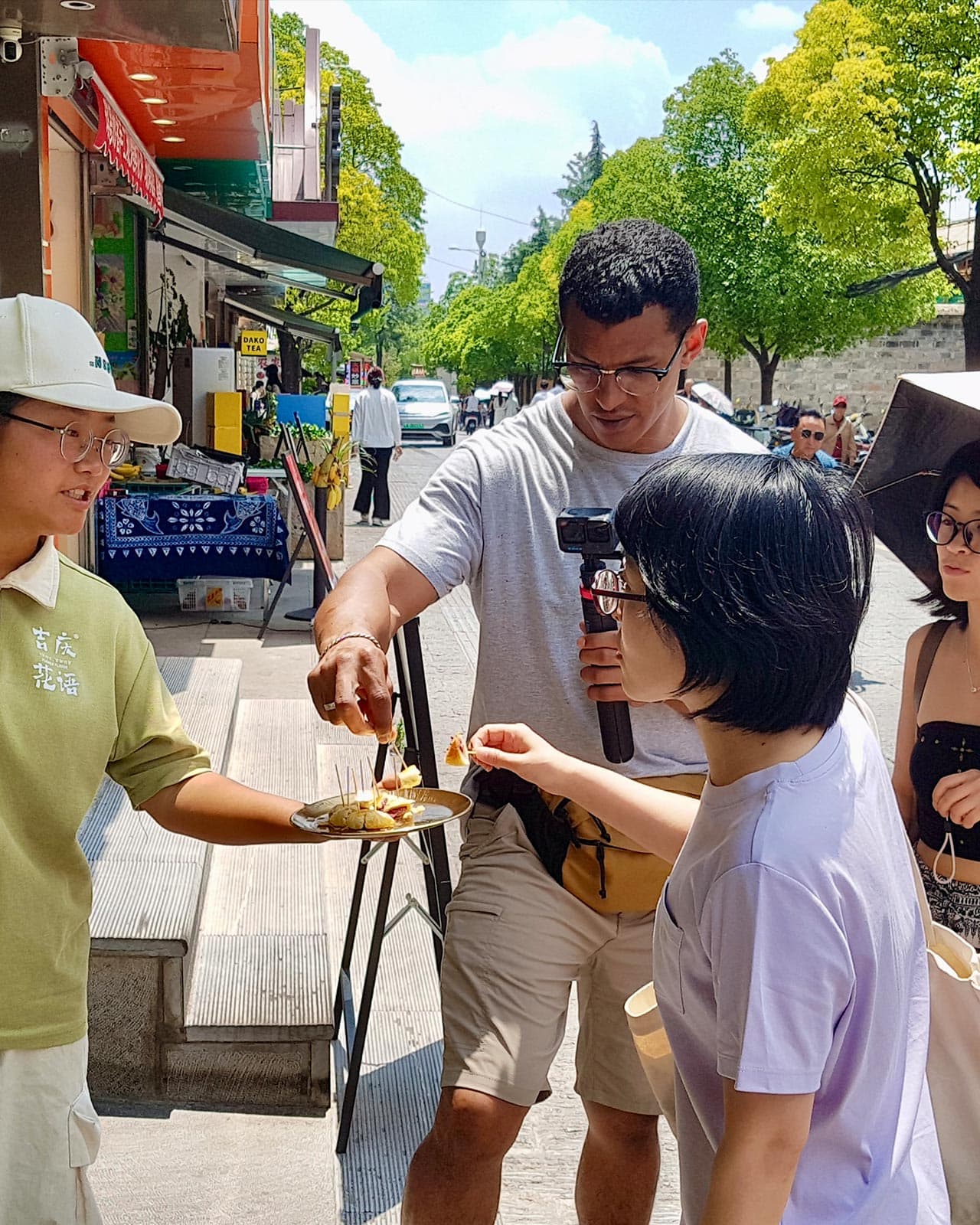
A flaky pastry filled with sugared rose petals — actual petals, not flavouring. Eat it warm if you can. Straight from the oven the pastry shatters properly and the filling is still soft. Our walking tour happens to pass by 吉庆花语现烤鲜花饼翠湖店 (Jiqing Huayu Freshly Baked Rose Cake, Green Lake branch) just on the side of Cuihu — and oftentimes they're ready with the freshly baked ones.
New visitors in particular find the flavour surprising, unlike anything they have ever eaten before. The room-temperature version is still a good snack to buy to bring home, if you're wondering what to bring back. Many stores sell them with pretty packaging. A good one is Happy Miss — a good friend of mine in particular really recommends it. I myself have bought it many times.
4. 汽锅鸡 · Qiguan Chicken
汽锅鸡, often translated as "Steam Pot Chicken," is one of Yunnan's most celebrated and unique dishes. The secret to this dish is that you don't add any water to the pot. (How?!) It is cooked in a special clay pot that allows the chicken to steam in its own juices, resulting in the most delicious and rich chicken broth ever.
If you're proper rich — like most Chinese people nowadays, hah, you don't even eat the chicken. You just drink the broth. The chicken is a bonus. But if you're not rich, you can eat the chicken too. It is tender and juicy, and the broth is still the star of the show.
You'll commonly find Qiguan Chicken with 三七 (sanqi or notoginseng) which is strongly associated with a very specific area of Yunnan (Wenshan), and is said to have medicinal properties. More than 90% of sanqi in China comes from Wenshan. Just sprinkle some of this sanqi magic onto your chicken broth and it would feel extra healthy.
The restaurant I usually go to is 福照楼汽锅鸡饭店 (Fuzhaolou Qiguoji Fandian) near the old town. The sanqi is optional - it costs a few yuan, you have to ask for it, and I'd recommend it. They sell other Yunnan dishes too, and pretty much everything tastes good.
5. 炸洋芋 · Fried potatoes, Yunnan style
Everywhere else in China the word for a potato is 土豆 (tudou). In Yunnan it is 洋芋 (yangyu) — which ironically means 'foreign', but this dish is identic to Yunnan. Well, it's not China if it's not full of contradictions.
It's hard to go wrong with this dish. Any street vendor would do. The potato is cut into chunks, fried, then tipped into a bag or a paper cup and tossed with dry chilli, salt, garlic paste, vinegar and coriander. There are only 2 categories: either it's "just good" or "really good".
Often they ask if you want 折耳根 (zhé ěrgēn) — a white root with a sharp, cold, almost medicinal taste that people either love or hate. (I hate it, oops.) Foreigners tend to react strongly to this one. It's definitely an acquired taste. The root, I mean. If you want to be safe, better to go without it. But if you want to try it, go for it. It is a very Yunnan thing. Maybe put it on the side instead of mixing it with the potatoes.
6. (Wild) mushroom hotpot
Yunnan produces more wild mushrooms than anywhere else in China, and for four months the restaurants rearrange themselves around them. From June to September the markets fill with fungi that have no English names, and the city loses its composure a little.
Hotpot is the way to eat them. A pot of chicken broth arrives, the mushrooms go in in a fixed order, and someone at the table times it, because several of the good ones are mildly toxic when undercooked. Every summer the local news carries another story about somebody who did not fry some mushrooms long enough and started seeing 'the little people'.
Restaurants cook it properly. They usually watch the foreigners like a hawk to make sure you don't do anything stupid, like not cook the mushrooms long enough. The locals swear by the WILD mushrooms. Swear that they taste proper different compared to the non-wild. Honestly, I can't tell the difference. I do know the wild ones are more expensive, so I guess you earn some bragging rights.
7. 蒸饵丝 · Steamed er-si strips
饵块 (erkuai) is rice, steamed and pressed into a dense cake, and it turns up all over Yunnan in different shapes. 饵丝 (ersi) is the same thing cut into strips, somewhere between a noodle and a rice cake to bite.
Steamed rather than fried, it comes soft and slightly springy under a sauce and pickled vegetable through it. I go to 靖晨园 for it. Again, it's a chain. It's everywhere, it's reliable, just go for it. They have a bunch of other small dishes on their menu too, including the ubiquitous fried pork strips (酥肉 sū ròu) — a definite Yunnan staple.
8. Roasted Eggplant salad
The Yunnan version worth looking for is pounded: aubergine roasted until the skin blisters, then worked in a mortar with garlic, green chilli, coriander and lime until it collapses into something rough and smoky. It is Dai food, from Xishuangbanna in the far south, and it tastes closer to Thailand or Laos than to anywhere north of here.
You can find a very cheap and fairly good one at 茄子恰恰 — another great chain. The version at the local market has the option to add the century eggs — which I love, but honestly the one at the chain is good enough, and you may hate century eggs anyway.
9. Flower dishes
Yunnan eats flowers, and does it casually rather than as a novelty. Rose is used in all kinds of pastries (see #3), but many flowers are also used as savoury dishes and stir-fried vegetables, cooked like any other green.
The easiest one to start with is jasmine flower fried with egg (茉莉鸡蛋 Mòlì jīdàn). It arrives looking like a plain omelette with white petals through it. Honestly it tastes just like a normal omelette. Almost any restaurant will make it if you ask, whether or not it is written on the menu.
Here jasmine is everywhere. If you want more, try the jasmine coffee, jasmine tea, or jasmine milk tea. Sometimes the jasmine is fresh, sometimes infused, but is always fragrant. For jasmine latte, I like the one by Luckin Coffee. You can find Luckin in every corner.
10. 烧烤 (Shāokǎo) · Barbecue
There's never a week go by without a local trying to get me to go for a shāokǎo. It is the most popular night food in Kunming, and it is everywhere. The smell of it is inescapable, and the city is full of people eating it at night.
However, an honest note: I'm not a fan. I don't have problem with the taste. The taste is good. I just don't like the way it makes me feel afterwards. My skin breaks out after. So I tend to avoid it.
There are so many little things people eat at a shāokǎo. Skewers go over charcoal, everything from tofu and mushrooms to potato slices and whole fish, and the tables spill onto the pavement until late. It is social food more than it is destination food, and the pleasure of it is mostly sitting outside for three hours with a beer, in a city where the weather permits that for most of the year. If that is what you are after, it is excellent.
One thing worth knowing
If you trace everything, a lot of these food are not from Kunming. So this is less a guide to Kunming food than a guide to Yunnan food eaten in Kunming, which is the only city where you can get through a lot of it in a week.
If you would rather walk yourself, I have written a self-guided walk around Green Lake. Twelve stops, one hour, free.
If you have a day or two, here's my guide on what to do in Kunming, and how many days you need.