
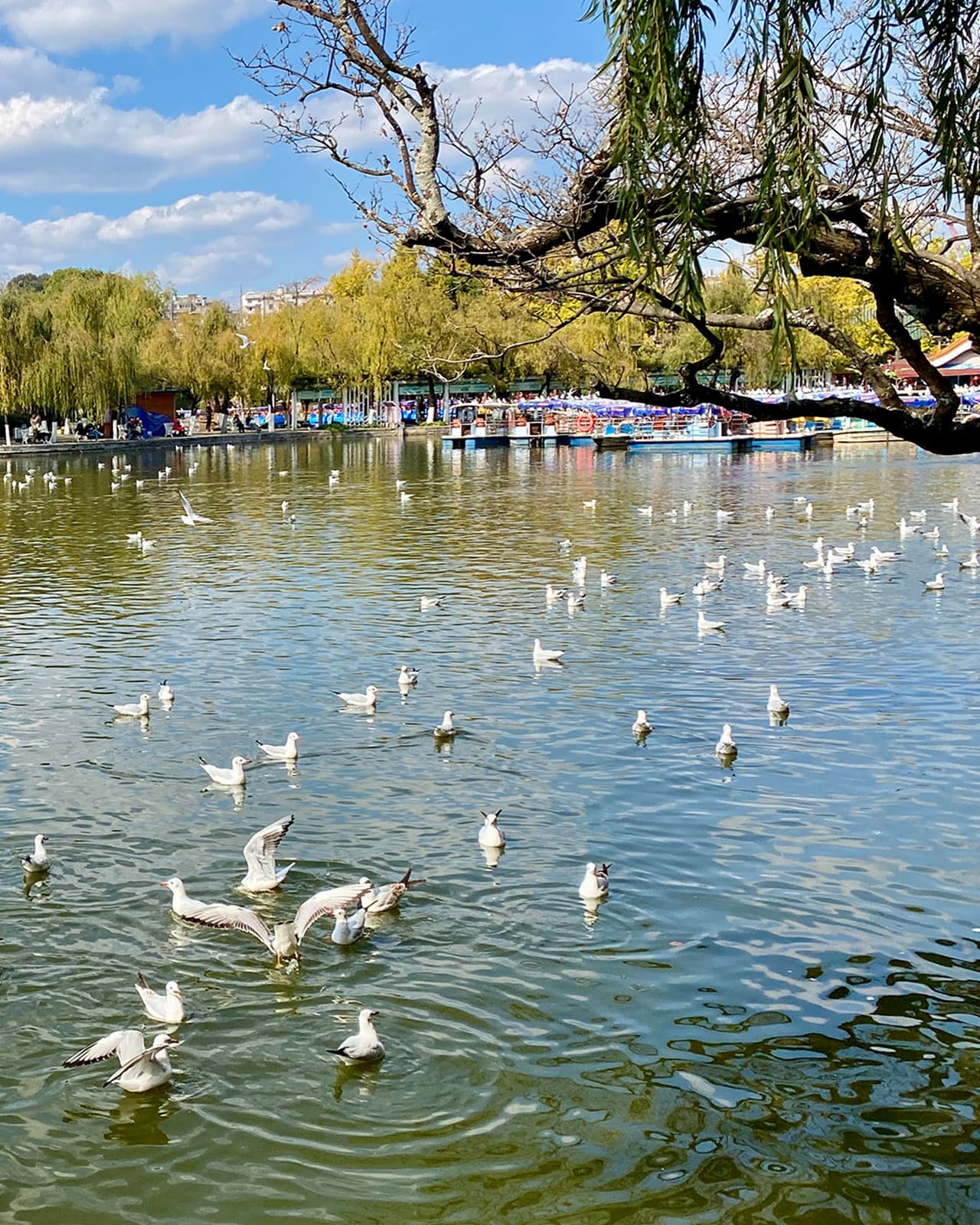
Green Lake — as Wang Zengqi says, is "the Eye of Kunming". But nobody here calls it Green Lake. In Chinese, Green Lake is Cuihu, 翠湖 or 翠湖公园 (Green Lake Park). 'Cui' is also green in Chinese, though it's not any type of green, more like jade colour. So from here onwards, Cuihu and Green Lake are interchangeable.
Though Cuihu has plenty of tourists, it is first and foremost, a very local lake. The locals do spend their time here. It is a place to walk, to sit, to watch, to meet, to play, to exercise, to taichi, to eat, to drink tea, to read, to write, to sing, to dance, to play cards and chess. It is a place for the elderly and the young. It is a place for the city.
When you've walked this park dozens of times, it seems easily navigable. But for a first-time visitor, it is a maze of paths, bridges, gates and courtyards. The things worth stopping for are not obvious, and the things that are obvious are not worth stopping for.
These are the twelve things we stop at on our Kunming walking tour, in the order we reach them, written out so you can find them yourself. Sixty minutes at a slow pace, free. But if you wish someone takes you around and tells you the stories, come join our Green Lake walking tour. We spend the first part in Cuihu (around an hour), and the second part in the surrounding areas around the old university district. A bunch of text, after all, cannot replace a person, like an AI can never replace a human connection. 😉
Before you go
Still working out whether Kunming is worth stopping for at all? Check out my other post.
Tours and tickets: Green Lake Park is FREE, there's no ticket and no entry gate. You can walk it yourself with this guide. But if you want to save time, make sure you don't miss anything important, and connect with local humans, walk it with us.
Hours: The park is open 24/7. Though I've never been at 2-3am in the morning. Would a 警察叔叔 stop me at the gate? I've been there late at night and there were still plenty of people around.
So the outer park opens 24 hours. The inner courtyard closes around 17:00. The inner courtyard is where the fish tower, the fish pond, and a few other spots are.
Best time: In the morning it is quieter and cooler. In the afternoon it's more crowded and warmer. Weekends have more people compared to weekdays. You decide what you want.
Best season: All year around. But the seagulls are only around from November to March, the camellia flowers from January to March, the cherry blossom along the eastern paths from February to March, and the lotus from June to September. There are also the jacaranda, and the tulips and the poppies and the roses, blooming at different times. You get the idea.
Start and finish: In at the Green Lake (Cuihu) South Gate, 翠湖公园南门, out at the Green Lake (Cuihu) West Gate, 翠湖西门.
Accessibility: The paths are paved and mostly flat, but there are some steps and some small bridges.
Twelve things worth stopping for
1. The poetry on the ground
Just outside the south gate. Look down before you look up. You may find a few older men writing characters on the paving with a long brush dipped in water, the characters holding for about a minute before they evaporate. He is writing classical poetry from memory. It is calligraphy practice, memory practice and something close to meditation at once, and the disappearing is not a flaw in the exercise. Like Chinese version of Zen garden. There is no schedule and no guarantee. Some mornings nobody is there.
2. The lake itself
Where the path first opens onto the water. A sweeping view of the lake. In the winter, the water is covered by seagulls. Many Chinese cities have a lake, Wang Zengqi wrote, and you could remove most of them and the city would still be itself. Remove Cuihu and Kunming would not be Kunming.
3. The 翠湖春晓 tablet
Straight, past the stalls. A stone tablet carries four characters: Dawn of Spring at Green Lake. A stone tablet that carries the name Cuihu. It is also a music piece written by Nie Er, who grew up in Kunming and spent much of his boyhood in this park.
4. The Old Man and the Gulls
On the right, beyond the cherry trees. A statue of the father of seagulls. The gulls first came to Kunming from Siberia in 1985, and nobody knows why. The old man loved the seagulls so much he spent half his pension on gull biscuits, and walked about ten kilometres to Cuihu each way, every day of the gull season, for ten years, to feed the birds.
5. The Long Yun stage
Through the gate into the stage courtyard. There's a toilet on the way. Unfortunately the stage has been under renovation since July 2026, so you will have to go around it.
This was the centre of Cuihu. It was once a Buddhist and Daoist temple, around two hundred years old, until a governor of Yunnan, Long Yun, had it converted into a secular complex and the main hall became a stage for Yunnan Opera.
The next few stops are inside the walled courtyard at the centre of the lake. It closes around 17:00.
6. The Fish Appreciating Tower, 观鱼楼
The two-storey building behind the stage. The name means exactly what it says, a building for looking at fish. It belonged to the Lotus temple complex built in the Qing Dynasty. The name is also taken from a famous old Dao story about the 'happiness of the fish'. Look it up!
7. The release pond and the happy fish
The pond below the tower. This is a 放生 fangsheng pond. Fangsheng means releasing living things: buying a captive fish, turtle or bird and setting it free as an act of merit. Temples across China have one, and some have more turtles than fish. The small stall in the corner used to sell feed by the bag, and boy, I had fun with my nephews.
8. The peacock
On the far side of the courtyard. A peacock motif is worked into the decoration. Yunnan is the only place in China where the green peafowl lives. It symbolises good fortune, beauty and peace. If you get a chance, you should go see the Dynamic Yunnan show, in which they show the peacock dance, and try the peacock banquet!
9. The old stone tablets
Along the outdoor corridor. A run of engraved tablets records Cuihu's history in classical Chinese. Two things they record are worth having. The lake used to be called 菜海子, the Sea of Vegetables, for the rice paddies and lotus beds that filled it. It was also called the Nine Dragon Pool, after the nine springs that fed it. Green Lake name came last.
10. The reflexology path
A few steps from the corridor, near the courtyard exit. A patch of cobbles set on edge. Take your shoes off and walk across it. The theory is that pressing particular points on the sole affects other parts of the body, and that the more it hurts the better it is working. In practice you find out how much softer your feet are than those of the local old grannies who always seem to be around.
11. Heart of the Sea Pavilion, 海心亭
Back outside the courtyard, to the left. The oldest surviving structure in Cuihu by far. Check out the paired vertical lines on the pillars called couplet. There's also the long couplet at Daguan Park, a few kilometres from here, runs to 180 characters and is the most famous in China, though a scholar in Jiangjin later wrote one nine times longer.
12. The camellia and bonsai garden
The last garden before the west gate. Camellia is Kunming's city flower and it flowers from January to March, so for most of the year this is a hedge. The trees in pots beside it are worth walking to the far end for. Most people thought bonsai is originated in Japan, but the word and practice come from Chinese: 盆栽, penzai, potted plant.
If you have another hour: the north east lake
In the north-east corner is the Nine Dragon Pool, the spring that gave Cuihu its older name. The building beside it was Kunming's first waterworks, pumping from 1917 until the water table dropped in 1956, and it now holds a small museum on how the city got its drinking water. Free to go.
On the eastern outskirt of Cuihu, there is also the Lu Han Former Residence, which also houses the Yunnan Uprising Memorial — with its quiet courtyard and French architectural style.
When you're ready to go for lunch, check out what I wrote about what to eat in Kunming.
Wondering what else to do in Kunming? Check out my guide on what to do in Kunming.
Walking Cuihu and beyond with us
A self-guided walk can tell you what a thing is. It cannot weave you all these little tidbits into a story and put everything together in a way that makes narrative or historical sense.
Our Kunming walking tour tells you why Kunming is the Most Foreign City in China, starts at the same south gate and runs close to three hours. After the west gate we carry on into the old university quarter, which is where the wartime history is. Cuihu is only the first hour and chapter. The real story comes next.
Written by Dioni, who lives ten minutes bike ride away from Cuihu and has walked this area way too many times.